
You want to engage B2B decision makers because these are the people who play important roles in business purchase decisions. Identifying and interacting with these individuals can help you close more deals successfully (and faster).
How do you reach and engage B2B buyers? Given the complex structure of most companies, it can be an overwhelming experience for many salespeople.
Explore the process of finding and engaging key B2B decision makers as quickly as possible.
Who Are B2B Decision-Makers?
B2B decision makers are individuals within an organization with the authority to approve or reject a potential purchase, control the budget, or influence any part of the procurement process.
In most large organizations, B2B decision makers comprise a group or a committee with their own priorities and concerns. In small companies like startups, one or two individuals could be making buying decisions.
In any case, B2B decision makers:
- Influence budget allocation;
- Have authority over final vendor selection;
- Set priorities for their department or company;
- Shape requirements for the solution.
For sales professionals, it is essential to research and understand the B2B decision-making process in their target organizations. This helps establish successful business relationships.
How to Identify Decision Makers?
The first step is to identify the right decision makers in your target company. This requires researching the organizational structure, buying roles, and authority levels.
First, define your Ideal Customer Profile, which is a detailed description of the company that would benefit the most from your solution.

Next, layers in Buyer Personas – these are basically behavioral profiles of your ideal customers. It involves identifying who controls budgets, who evaluates solutions, and who signs contracts.
Once you have identified a target company, it’s time to do some mapping of the organization.
- Start with LinkedIn. Look at the company’s LinkedIn page and map out the important title holders. Pay attention to recent promotions or new hires, as these individuals are often more open to new ideas. Discover how to find decision makers on LinkedIn in more detailed article;
- Use your existing network. Check your CRM to see if anyone in your network has a connection to the target company. A warm introduction is more effective than a cold call;
- Analyze content engagement. Check out your website analytics to find who is visiting a certain page. A Director of IT repeatedly visiting your product page is a very strong signal of a potential lead;
- Listen on social platforms. Notice which individuals from your target accounts are speaking at events or posting about industry challenges. They are actively telling you their priorities;
- Keep an eye on the news. Industry news or press releases show who announces partnerships;
- Interact with gatekeepers. Direct conversations with individuals who control access to decision-makers can uncover who makes final calls.
The Key Personas in B2B Decision-Making
Key B2B decision makers include economic buyers, budget holders, internal advocates, end users, and technical buyers or evaluators.
The Economic Buyer
The economic buyer holds the purse strings. This is often a C-level executive like the CFO or CEO, or a VP-level head of a department. Their primary concern is return on investment.
An economic buyer wants to know how your solution will impact the bottom line, increase revenue, or reduce significant risk. These people ask questions about cost, ROI, and strategic alignment.
The Budget Holder
The budget holder is the person within your target company who has the authority to allocate and approve spending for a particular purchase or project.
Unlike influencers or end users who may shape the decision, the budget holder controls the financial resources and decides whether money will be committed to your solution. This individual is usually a manager, director, or executive, depending on the size of the organization and the deal value.
The Internal Advocate
This person, often a department head or a senior manager, believes in your solution and will fight for it internally. They see your product as an answer to their team’s daily pains.
Your goal is to arm your internal advocate with everything they need to make your case to the economic buyer and budget holder.
The End User
This could be an individual or a team that will use your product daily. A Manager or a team lead is a good representation of an end user.
While they may not control the budget, their input and approval are vital for closing a deal. If they don’t see the value or think it will make their job harder, they can veto the deal. They care about usability, features, and how it will integrate into their daily workflow.
The Technical Buyer or Evaluator
The technical/blocking buyer, like someone from IT or Security, has the power to say “no” for technical reasons. These guys evaluate security protocols, data integration, scalability, and compliance.
How to Reach B2B Decision Makers
Once you’ve identified the key personas in B2B decision-making at your target company, you want to connect with these people. But successfully reaching these decision makers is not easy.
You need a strategic and highly personalized approach to draw the attention of these individuals.
The first step here is to revisit your Ideal Customer Profile and Buyer Persona. These documents will provide you with critical information that you can use to personalize your outreach.
For example, you can personalize your LinkedIn outreach, email, or call using the demographic, firmographic, and behavioral information of your target company. And then you can further hyper-personalize your outreach by strategically integrating each decision maker’s goals and challenges.
It is also essential to fully understand the hierarchy and roles of the decision makers.
Research the company to learn about the B2B decision-making process and the layers of decision makers. This will help you reach out to the right people, whether it is a single decision maker, multiple individuals, a formal committee, or an ad hoc team.
It is always best to use multiple channels to reach these B2B decision makers.
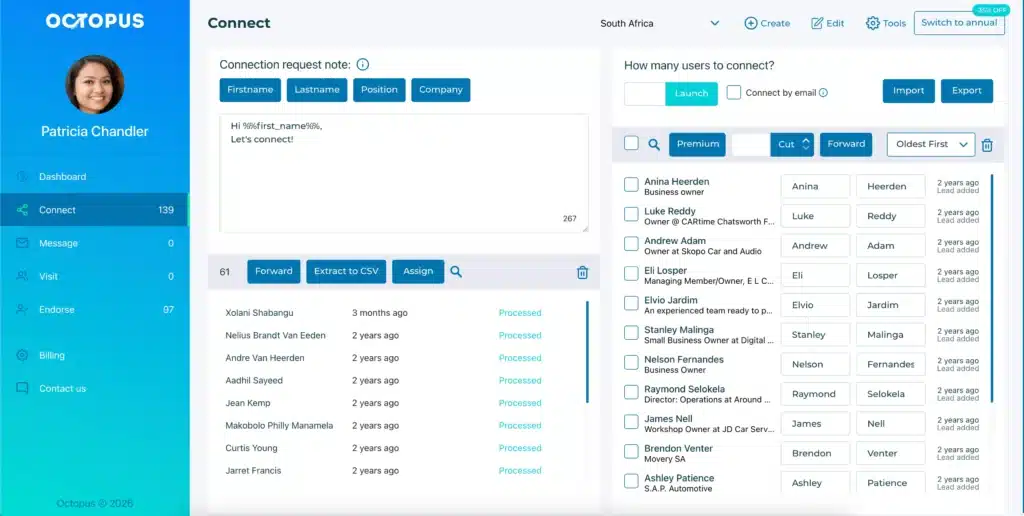
- LinkedIn outreach – Use Octopus CRM LinkedIn auto connect tool to send personalized connection requests in bulk;
- Email outreach – Write clear, relevant subject lines and value-driven messages;
- Referrals – Use introductions from mutual connections or existing customers to get the attention of the decision makers;
- Events and webinars – Decision makers attend industry events. If you also attended the same event, use it as an opportunity to connect with them on LinkedIn or via email;
- Content sharing – Share useful insights like industry reports, case studies, whitepapers, and relevant articles with the decision makers.
How to Engage B2B Decision Makers
To engage B2B decision makers, your conversations should focus on their business challenges instead of your product. Your message must demonstrate value, relevance, and timing.
Even if you talk about your product, mention the benefits and outcomes instead of features. Try to use Octopus CRM sales automation software to communicate and promote your product on LinkedIn.
If you’re communicating with an economic buyer, remember that they care about market share and profitability. On the other hand, an end user wants to know how your solution will improve their workflow and increase efficiency.
It is also a good idea to adopt insight-led selling strategies to engage B2B customers.
This involves introducing these individuals to new perspectives on their business or industry. Using this approach, you can build a reputation as a trusted advisor who provides value instead of a sales rep pushing a product.
For example, you can mention a problem or challenge they might not have considered and then describe how your product solves that problem.
When your outreach is clear, transparent, and proof-backed, it helps engage B2B buyers and close deals successfully and more quickly. This means you need to show them why your product is essential for their business. You can do this with the help of case studies, benchmarks, and examples of results other companies have achieved with your product or service.
Also, when you’re thinking about how to engage B2B influencers, remember that not every influencer in the purchasing process signs the check. However, they have the power to sway the decision maker in one way or another. They may be end users, gatekeepers, or middle managers. When you build trust with them, they can advocate for your product internally.
Tips to Engage B2B Decision Makers
To engage B2B customers, use a personalized, structured, consistent approach for your outreach and conversations.
- Research the company’s financials, news, and priorities before outreach;
- Tailor your message for each B2B buyer. Mention business outcomes relevant to their role instead of making generic promises;
- Your outreach, especially your initial message, should be short but strong enough to draw attention and elicit a response;
- Use proof points. Share specific numbers or case studies showing measurable results;
- Decision makers value efficiency. Avoid long pitches or vague meetings;
- Ask smart questions to demonstrate your curiosity about their goals rather than quickly offering solutions;
- Identify and engage B2B influencers. Don’t overlook the people who can affect buying decisions internally;
- Bring stakeholders together. If you’re talking to a champion and an evaluator, suggest a joint call with the economic buyer. It shows you understand the process;
- Track engagement signals. Did they open your ROI sheet? Watch your demo video? That shows they’re interested, so follow up fast;
- Always provide a clear next step. This maintains momentum and prevents the deal from stalling.
Conclusion
Learning how to engage B2B decision makers is a methodical process. It starts with identifying the decision makers, creating an Ideal Customer Profile and Buyer Persona, and understanding the complex decision-making process in your target company.
Decision-making in most organizations involves multiple stakeholders, with each one having different priorities. A well-researched and structured approach, as explained above, will help you know where to focus your energy and close more deals faster.